Tuesday, April 3, 2012

That's a Wrap: Part 4

 
It's our last visit to London for a while, so why not go back to Ye Olde Cheshire Cheese for lunch and another dose of its gloomy charm. According to a plaque nearby, Charles Dickens operated out of the Cheshire Cheese pub while working on his journal All The Year Round.

The entrance has almost been worn away. This metal grill protects what's left of the original stone step. It also provides a more predictable exit for intoxicated patrons.

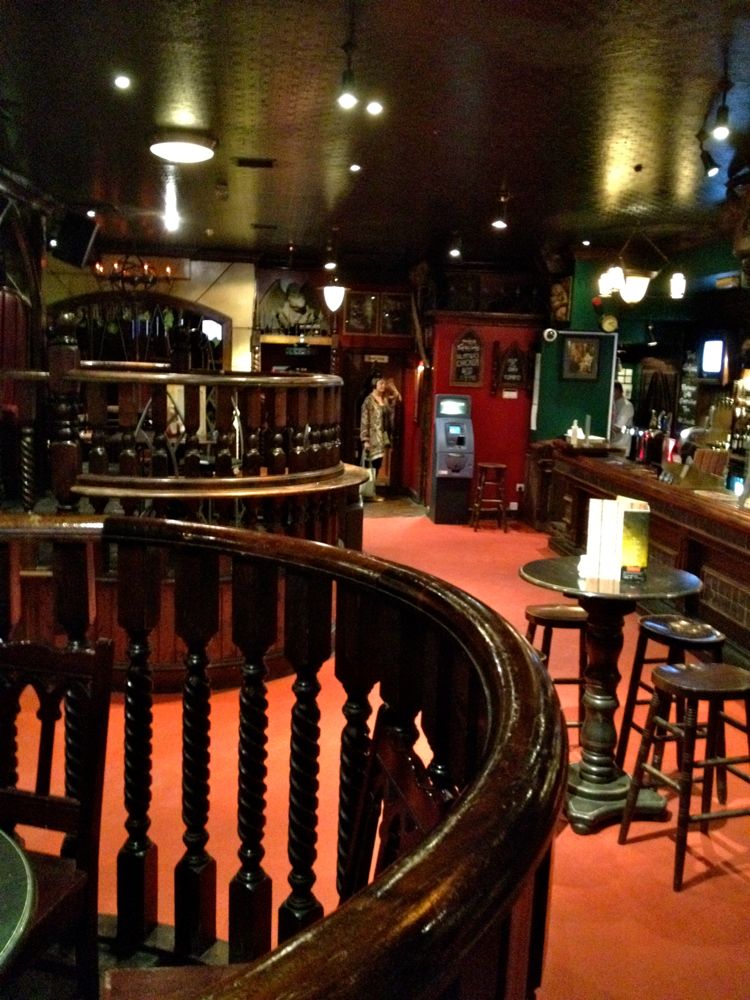
The front bar is small, gloomy, and charming. There are four bars tucked away in the rabbit warren-like pub. Or, at least, that's how many we've found so far. On our last visit here, we didn't explore downstairs beyond the restrooms. But this time around, we found some stairs just past the restrooms that took us to some small wine cellar rooms, then some more stairs that went to yet another bar.

Maybe I'm just a gloomy guy, but I think this is the perfect atmosphere for enjoying a cider.

Looks like someone needs another gloomy glass of wine.

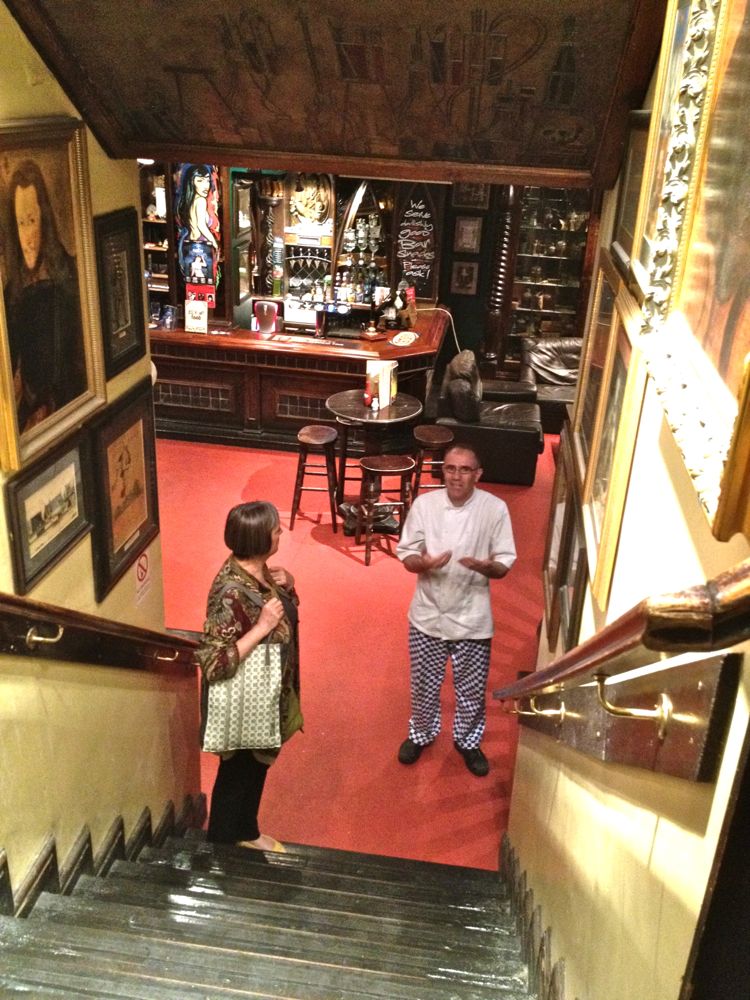
After ordering food from the bar below, I searched for our table and Robin. Aha, found them.

These stairs go from our gloomy table, down and to the left, to a gloomy bar below.

The bar below. The Tube isn't the only Underground here.

Here's to Ye Olde Cheshire Cheese. Robin points out that the phrase "Ye olde" comes from the misunderstanding of old writing of the words "The olde." The drawing of a "T" in old manuscript writing usually looked like a "Y" and the use of the incorrect phrase "Ye olde" became common.

An iconic UK sight, for me. A bubbling pint of cider. Lots of bubbles. Pints of cider are usually served filled up to the brim of the glass. This pint partially empty because I've already had a sip. Lest ye think I have ye olde cider problem, let me remind you that cider is a very mild drink, about as potent as apple juice.  

As you can see from the bubble-inducing pattern in the bottom of the glass, we're drinking cider from an Arcoroc glass. They make glassware for restaurants. If you can figure out what the symbols mean, let me know. The important thing is, the dots make bubbles. 

After a typical pub meal (cottage pie) and a farewell to Ye Olde Cheshire Cheese, we leave the pub's small side street and make our way to Aldwyche Street and the Novello Theatre to see Noises Off.

That's a Wrap: Part 3

St. Bride's Church. They say this spire is the inspiration for the traditional bride's cake. This might be one of the oldest churches in London. It's at least the seventh church built on this site, going back to the 7th century. In the late 1580s the parents of Virginia Dare (the first English child born in America, on Roanoke Island in 1587) were married here.

St. Bride's close-up. 

St. Bride's even closer-up. This small and quiet secluded courtyard, just a few steps off Fleet Street, seemed to be a popular place for a lunchtime snack.

Next to St. Bride's is The Old Bell pub. I'm sure it has a history, like the other dozen pubs in this block, just off Fleet Street, one of London's prominent streets (famous as the street of journalists and printers).

Pubs in the city are full of suits. Usually with young guys in them, smoking. Lots of young women in suits also. Especially around 5 p.m.

Among the old, historic buildings, modern streetscapes coexist.

We stumbled across The Cartoonist pub, a must-have photo for me. 

The walls are covered with vintage, original cartoons. I assume some cartoon friends originally started this pub. Now, as we've come to expect, the people who work here don't know anything about it's history or have any idea why it's called "The Cartoonist." In the late 1940s, from what I could find online, a group of cartoonists met here regularly to draw from life and to critique each other's work. 

That's a Wrap: Part 2

St. Paul's Cathedral is a popular place to gather. Most of these people are teenagers, waiting for the tour group leader to give them instructions. This reminds me of how we kids used to hang out in front of the First Baptist Church in my home town, waiting for the evening service to begin. Mmmm, maybe not so much, now that I think about it.

A statue something like this would have been nice in front of my hometown church.

In front of a building that face St. Paul's, a series of six columns stand watch, called Angels.

How great is this? Very.

London. Great art everywhere.

Love it.

Walking up Aldersgate Street, where Mary Sidney had a house (and where she died), Robin took me to  Postman's Park. In the park is a small memorial to Heroes who died saving (or trying to save) other people's lives (it can be seen in the background).

The simple monument exhibits ceramic plaques that honor people who died in heroic acts of courage.


A London walk keeps your camera busy.

That's a Wrap: Part 1

Robin and I were on different flights home. A couple of years ago a flight scheduling mix-up had resulted in her having to buy a round trip ticket home, which meant the return half of the ticket was always back to London. So to get home this time, she had to buy a one-way ticket back home. A one-way ticket on my United flight was so outrageously overpriced that she booked another airline. Still overpriced, but a bargain compared to United. So we had coffee together in Terminal 3 at Heathrow, then said "See you in Albuquerque" as we parted to look for our gates.

The final photos of our three-month journey are below and in the next blog or two. Meanwhile, memories of London, Uxbridge, Oxford, Paris, Istanbul, and Ireland are echoing in our heads. 

On our last trip in to London, we passed by this statue of Boadicea, on the edge of the Thames.

Boadicea, legendary warrior who lead her people against the Roman invaders in 61 A.D.

View of the Thames and the London Eye from the Boadicea monument.

Another view of the Thames from the Boadicea monument.

One of our quests of the day was to find The London Stone, an ancient stone that no one knows the origin of, and that the Romans used as the place from which all distances were measured. We found the general vicinity, then asked a postman who was delivering mail to a building if he knew where The London Stone was located. He didn't have a clue. Had never heard of it, in fact. But a woman entering the building gave us directions and we were about a half block away from it. See the small grill built into the wall above. Yep, that's it. It's behind the protective grill. In most places this artifact would be the star attraction. Here, it's just a minor piece of rubble that hasn't been tossed yet.

  
If you get really close and look through the grill, you can barely see a stone behind a pane of glass. The glass reflection made it impossible to photograph. Notice the lack of wonder and amazement of local passersby. They probably wondered why in Heaven's name we were shooting photos. Crazy American tourists.

A few steps away from the actual stone is the London Stone pub. Aha, they're certainly aware of the stone. Nope, nice try. As we take the steps downstairs into the pub, a sign says "Welcome to the World of John Dee and Magic!" John Dee! Wow. He was Queen Elizabeth's astrologer and alchemist, he was closely associated with Mary Sidney and her family, and he took on Mary's brother, the famous and beloved Philip Sidney, as a student. Guess what... you know what's coming... the employee inside had never heard of John Dee. Even though there's a larger sign as you enter, and the interior of the place is designed to look like an alchemy laboratory from the 15th century, and theres a framed document on the wall explaining who John Dee was. Notice the chalkboard on the right says "We're the sexiest basement pub in London." Yes, if sexy means an atmosphere of 15th century occultism, alchemy, and magic. After reading the sign, we assumed it was some sort of porno pub. But then we saw the John Dee sign and thought "our kind of place." 

Very John Dee, as far as I can tell. 

Robin examines the alchemy cabinets. I'd call it 15th century "Chili's" or "Friday's."

Probably a popular place at Halloween.

Robin educates the help on who John Dee was. He promised he'd read the John Dee document on the wall.

15th century versions of cubicles.

 15th century booth. Slightly creepy, but fun.

On the left, stairs lead to the street. Lots of book cases built into the walls.

This way to the ladies room. Perfect.

After a quick visit to the National Portrait Gallery at Trafalgar Square, we crossed the street for lunch in the Crypt Cafe. This crypt, underneath a historic church, has been converted to a very good cafeteria-style cafe.

Sculptures by a Polish artist greet us as we enter the Crypt's street-level entrance.

The cafe's food line.

Very crypt-ish. 

I guess this means people are still buried here.

A great place for lunch if you're in the area.

Hey pal, what're ya doin'? Waitin' for a shoe shine? Read the sign.

Tube passengers. At least two of them are having fun.

Friday, March 30, 2012

Last Day in London

Since Friday is packing day, and we have to be at the apartment when Seven Seas shipping company arrives to pick up our 5 cardboard boxes of stuff, we Tubed into London on Thursday for one last time. 

Our agenda included finding the London Stone, the former location of Mary Sidney's house on Aldersgate Street, the Bodicea Statue on the Thames, lunch at the Crypt, dinner at Ye Olde Cheshire Cheese, and an evening performance of Noises Off (a comedy that's getting great reviews).

We accomplished all of that, and I'll post photos as soon as possible (probably after I get home because we leave for Heathrow at 7:30 in the morning). Meanwhile, without comments, here are a few sample photos.